Canadian Government Considering Reparations for Mennonites

Mennonites accuse the Government of Canada of bargaining in bad faith when photo provided during negotiations showed Kielke and not Vereniki as indicated in the text of the agreement

After years of inaction the Government of Canada is considering making reparations to Mennonites for ,close to a century of failure to live up to its obligations under the provinces of the Priviligium of 1873. 

The Priviligium passed by Order In Council was designed to entice Mennonites from South Russia (now Ukraine) to immigrate to Canada. It resulted in some 7000 Mennonites moving to Canada between 1875 and 1885. 

The Priviligium provided Mennonites with 15 guarantees the most important from the Mennonite perspective being freedom of religion, exemption from military service, the right to run their own schools using the German language and free land. 

Although the government has admitted to violating its agreement with the Mennonites, the government has essentially told Mennonites to go to the ‘back of the line’ as it has more important groups to deal with. It would appear that the government is confident that because Mennonites are pacifists it has nothing to fear in terms of any militancy by the Mennonites. 

Preliminary discussions have focused on how to ‘restore’ the position of those Mennonites who immigrated to Mexico and points beyond in 1927 and 1948 wholly based on the the government’s failure to honour its 1873 agreement with the Mennonites. 

To this point the government has floated the idea of providing an annual free dinner to all Mennonites in Canada and Mexico. The dinner would include vereniki and foarma worscht complete with schmaunt fat. As well, men of voting age would each receive a pair of schlaubbekjse every second year and women would receive en duak every 3rd year. 

To this point Mennonites have rejected the government’s offer and negotiations are ongoing. The Mennonites have suggested to the government that as a sign of good faith and respect they should learn the difference between Kielke and Vereniki.
Will the Brommtopp make a come back?


img-2
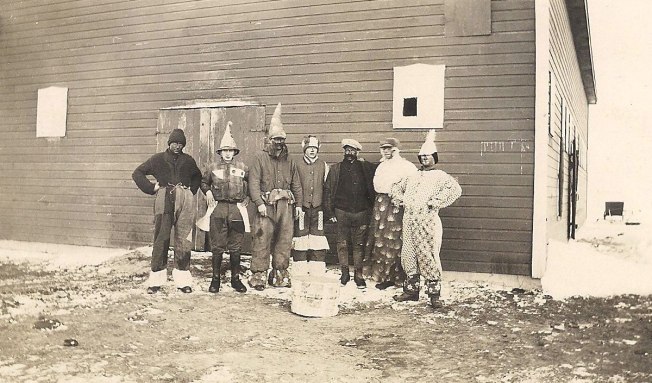
Brommtopp troupe from the mid 1930’s


brommtopp
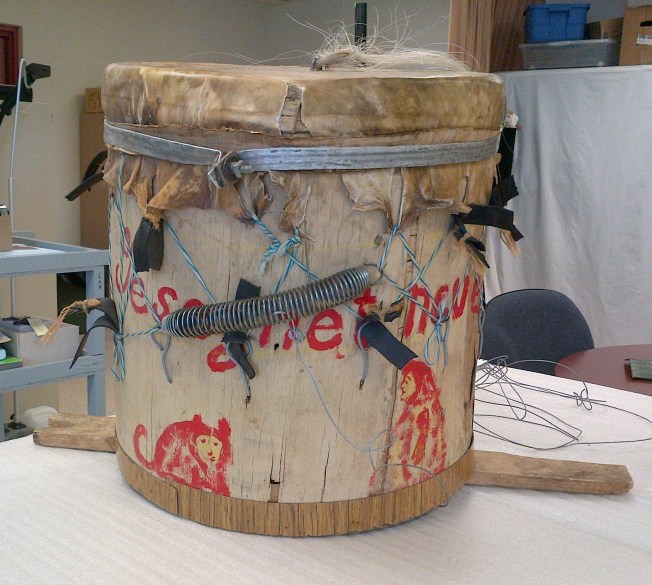
The Brommtopp instrument

Sommerfeld MB

Spottschreft has learned that many of the residents in the Southern Manitoba villages of  Sommerfeld, Neubergthal and Gnadenfeld were disappointed  when the Brommtopp troupe once again failed to make an appearance on New Year’s Eve.

Noted Edgar Klippenstein, 89, of  Sommerfeld,  “I think it’s been since 1937 that I last remember the Brommtopp coming around, I was just a kid then”.

The tradition of the Brommtopp which was practiced in many Mennonite Villages on ditsied, saw young men dressed in costumes go from door to door on New Year’s Eve providing entertainment in the form of songs and sometimes skits to entertain homeowners they visited.  In return the performers were given gifts in the form of food and drink including homemade chokecherry wine and brandy.

The center piece for the tradition  was the Brommtopp, a drum-like musical instrument with a horsehair tail attached to one end which when played made a very loud ‘brrrumming’ sound which alerted homeowners that the group had arrived.

Spottschreft was able to interview a man from Gnadenthal, who would only identify himself as ‘Jake’.  He indicated that he thinks he knows why the Brommtopp has not been seen for the past 79 years, stating, “My great grandfather was part of the last group that performed in 1937.  They visited the home of Wilhelm Schmidt in the village of Sommerfeld.  After their performance they were given portselkje and a large jug of Mrs. Schmidt’s homemade chokecherry wine.  The wine was meant to be shared by the entire group but by the time they got to Neubergthal all the wine had been consumed by just three members of the group who were now so drunk that the performance had to be cancelled.  The Brommtopp actually fell out of the sleigh they were riding in and was damaged.”

‘Jake’ indicated that his grandfather and the other members of the Brommtopp troupe came under close scrutiny by Church Elders and were only able to avoid excommunication by agreeing to disband the group and promise to destroy the Brommtopp instrument.

Noting that there is renewed interest in the Brommtopp, ‘Jake’ finished on a tantalizing note, adding that the tradition may be revived in the coming years.


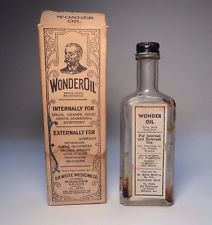
Neubergthal woman rediscovers Wonder Oil

s-l225bigbottle

Neubergthal MB

During a recent trip to Winnipeg, Rebecca Hamm who lives in the Village of Neubergthal, made an amazing discovery.

Wonder Oil is still on the market.

Gone is the rectangular glass bottle with the black metal screw top and the iconic cardboard box, but  Wonder Oil still exists.

Hamm, who is now 61, fondly remembers her grandmother Tina Wiebe (one her mother’s side of the family) who always kept a bottle or two of Wonder Oil on hand for emergencies.

“During family gatherings when it was crowded and all the kids were running around someone would always end up bumping their head or their shin”, says Hamm, .  “That’s when gramma would go in the closet and bring out the Wonder Oil  and apply it to the injured area and pretty soon the games were on again”.

Not knowing when she would run across Wonder Oil again Hamm bought four bottles.

Although it is no longer recommended for internal use, as was the case with the original Wonder Oil, its other claims are still much the same.  According to Hamm the Wonder Oil currently available smells a little different than it used to, “it has more clove oil in it than it used to”.